

Looking for the perfect card game for your next family gathering or game night? Meet 3-13. It’s famously easy to learn, works wonderfully as a card game for large groups, and has a clever twist that keeps every single round exciting. Unlike games that require intense strategy from the first deal, 3-13 lets players jump right in, making it a favorite for mixed crowds of all ages. To know more, check out ufa14k
The goal in 3-13 is to finish with the lowest score possible. This simple flip of objectives creates a unique dynamic. You aren’t trying to collect powerful cards; you’re trying to get rid of them before someone else ends the round, leaving you with points you don’t want.
The game itself changes with every deal. In the first round, you’re dealt three cards and 3s are wild. In the next, it’s four cards and 4s are wild. This progression continues all the way up to thirteen cards with Kings as the wild card, ensuring no two rounds ever feel quite the same as the challenge grows steadily.
This guide will walk you through exactly how to play the 3-13 card game, from setting up your first hand to forming card combinations and “going out” to win a round. You’ll have all the tools you need to deal the cards and start the fun.
What You Need to Start Playing 3-13 Tonight
Getting a game of 3-13 started is quick and easy. First, you’ll need the right number of standard 52-card decks (jokers removed). The amount depends on how many people are playing, as you want to make sure you don’t run out of cards mid-round. Here’s a simple guide:
- 2 to 4 Players: 1 deck
- 5 to 8 Players: 2 decks
- 9 or more Players: 3 decks
Once you have your cards, you need to pick a dealer for the first round. The fairest way is to have each player draw one card from the shuffled deck. The person who draws the lowest card (Aces are low) becomes the first dealer. This role is important, but it moves to the next player on the left after each round, so everyone gets a turn.
The dealer has two jobs at the start of each round: shuffle the deck(s) thoroughly and deal the cards. The number of cards dealt changes each round, starting with three. After dealing, the dealer places the remaining cards face-down to create a draw pile and turns the top card over to start the discard pile. Now, you’re ready for the first player to take their turn.
Your Turn in Two Simple Steps: Draw and Discard
Now that the cards are dealt, the player to the left of the dealer starts the game. Every turn in 3-13 follows the same simple rhythm: you draw one card, and then you discard one card. This two-step process keeps the game moving quickly and makes it easy for anyone to follow along. Your goal during this turn is to improve your hand, moving closer to being able to “go out.”
Your first action is to draw, and this is where your first bit of strategy comes in. You have two choices: either draw the top card from the face-down draw pile (the “stockpile”), which is a complete mystery, or pick up the face-up card on top of the discard pile. This is a key part of the 3-13 discard pile rules, as taking this known card can be a huge advantage if it helps you build your hand.
After drawing, your hand will have one extra card. To end your turn, you must choose one card from your hand to place face-up on that same discard pile. The card you get rid of should be the one that seems least useful for building combinations. This simple cycle of drawing and discarding is how you’ll work to improve your hand each round.
The Building Blocks of a Winning Hand: Sets and Runs
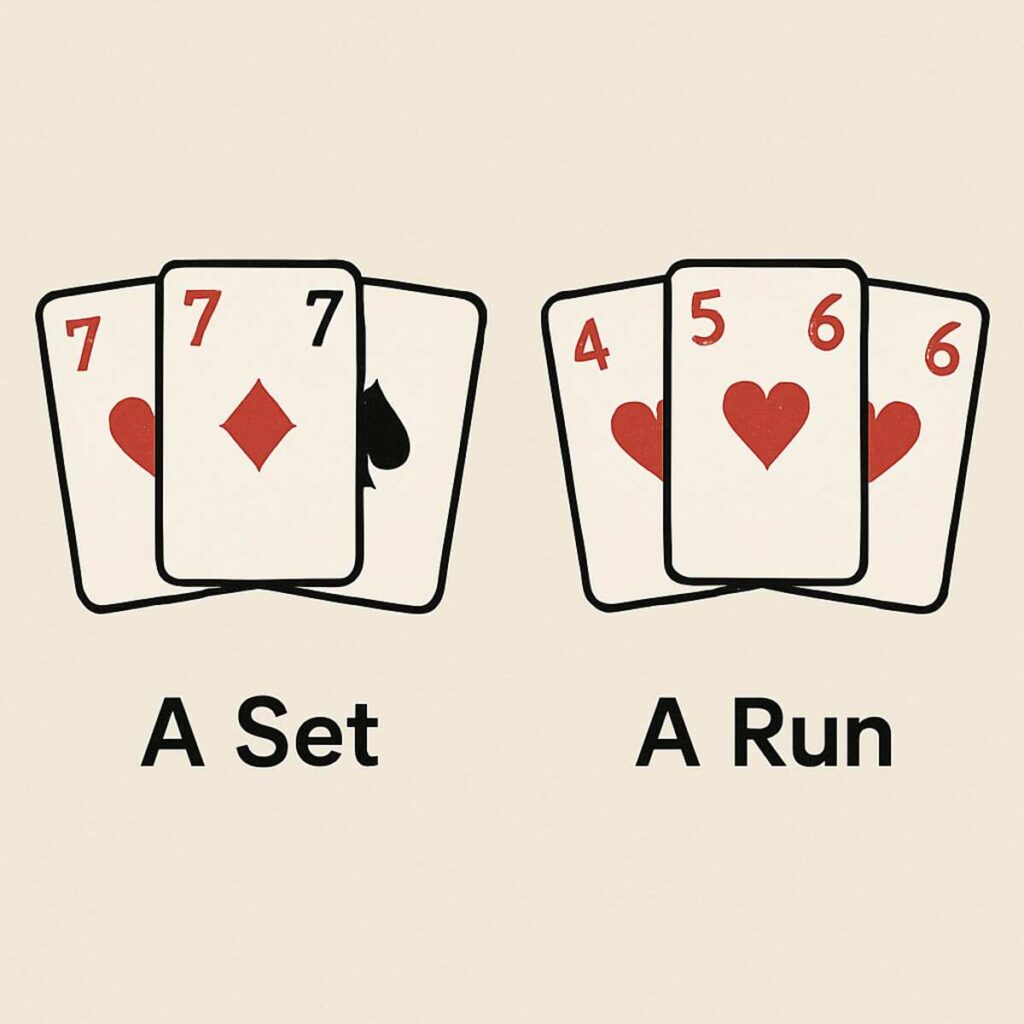
In 3-13, a “useful” card helps you form one of two specific types of combinations. The first and most straightforward is a Set. A set is a group of three or more cards that share the same rank (the same number or face). For example, if you were holding the 8♥, the 8♠, and the 8♣, you would have a set of eights. The suits don’t matter; it’s all about matching the rank. Four 5s or five Queens would also be valid sets.
The other key building block is a Run. Unlike a set, a run is all about sequence and suit. A run is a group of three or more cards of the same suit in numerical order. Think of it like a straight from poker, but they all have to be hearts, diamonds, clubs, or spades. For instance, the 4♦, 5♦, and 6♦ make a perfect run. Sets are about matching ranks, while runs are about sequential suits.
Aces have a special role when you’re building runs, giving you valuable flexibility. An Ace can be used as either the lowest card in a run (like A♠, 2♠, 3♠) or as the highest card (like Q♠, K♠, A♠). However, you cannot use an Ace to “wrap around” the sequence. A group like K♠, A♠, 2♠ is not a valid run. This rule makes Aces powerful, but you still have to use them at one end of a sequence or the other.
Your objective is to organize all the cards in your hand into these sets and runs until you have no leftover cards. The moment you can do this, you can “go out” and end the round. The game’s clever twist, however, helps when you’re just one card away.
The Twist in Every Round: Understanding Wild Cards
That single missing card you need is exactly where the game’s best feature comes into play: the Wild Card. Think of a wild card as a chameleon; it can become any card you want it to be to help you complete a set or a run. For example, if you’re holding two Kings (K♦, K♣) and you draw a wild card, you can declare that wild card is a third King, instantly giving you a set.
The wild card is always tied to the number of cards dealt in that round. In the first round, you are dealt three cards, making all the 3s in the deck wild. When you move to the next round and are dealt four cards, the 4s become the new wild cards. This pattern continues all the way up to the final round where Kings are wild, providing a simple round-by-round guide to follow as you play.
The power of wild cards lies in their flexibility. You can use them anywhere in a combination, and you can even use more than one at a time. For instance, if 8s are wild this round and you are holding a 10♦ and a Q♦, you can use an 8 to act as the J♦ and complete your run (10♦, J♦, Q♦). This ability to fill any gap is what helps you organize your entire hand and prepare to win the round.
How to “Go Out” and Win the Round
All that effort you’ve put into collecting sets, completing runs, and using wild cards is building toward a single, game-changing moment: “Going Out.” This is how you win the round. Going out happens when you can organize every single card in your hand into valid combinations. You don’t need to have any cards left over—you’ve successfully solved the puzzle of your hand.
The big moment arrives on your turn, right after you draw a card. If that card allows you to form your entire hand into complete sets and runs, you can go out. To do this, you lay all of your combinations face-up on the table for everyone to see. To officially end the round, you must have one card remaining to place on the discard pile. This final discard signals that you have gone out with a perfect hand, earning you a score of zero for the round.
Once a player goes out, this triggers the last turn for everyone else. Every other player gets one final chance to improve their hand. They will each take one more turn—drawing and discarding—to try and form their own sets and runs or get rid of high-point cards. It’s a crucial last-ditch effort to minimize the points they’ll be stuck with.
After every other player has taken their final turn, the round is officially over. Anyone who couldn’t go out is now left holding cards that don’t fit into any combination, and these leftover cards are what will cost you points.
How to Score Your Hand (and Keep It Low)
In 3-13, the goal is simple: keep your score as low as possible. The player who successfully “goes out” achieves the perfect score for the round: zero points. For everyone else, the game becomes about damage control. Your score for the round is determined by the cards you’re still holding after everyone has taken their final turn. The lower the total value of these leftover cards, the better.
Any cards left in your hand that aren’t part of a complete set or run now count as points against you. Keeping this 3-13 card game scoring system in mind is key to playing smart.
Here is the breakdown of what each leftover card is worth:
- Cards 2 through 9 = 5 points
- 10, Jack, Queen, and King = 10 points
- Ace = 15 points
- Wild Card = 20 points
Notice that holding onto a wild card at the end is the most expensive mistake you can make. If you don’t think you can go out, it’s often wise to discard a wild card to avoid that hefty 20-point penalty.
For example, imagine the round ends, and after making a final set of 8s, you’re left holding a 4♠ and a Jack♥. You would calculate your score as 5 points (for the 4) + 10 points (for the Jack), giving you a total of 15 points for that round. Your score is then written down, and you get ready for the next hand. The game continues round after round, with each player’s score adding to their running total. After the final round is played, the person with the lowest overall score wins the entire game.
The Full Game: A Round-by-Round Guide from 3 to King
The game isn’t just a single hand; it’s a series of eleven rounds that grow in difficulty. You start with a small, manageable hand of three cards and gradually work your way up to a challenging final round with thirteen cards. This progressive structure is what gives the game its name and keeps every hand feeling fresh and exciting.
The beauty of this system is its simplicity. The round you are on tells you how many cards to deal and which card is wild. So, in the “5s round,” the dealer gives everyone five cards, and all 5s are wild. This complete 3 to King card game instruction ensures everyone can easily follow along.
Here is the complete 3-13 card game round-by-round guide to use as a cheat sheet during your game.
- Round of 3s: Deal 3 cards — 3s are wild.
- Round of 4s: Deal 4 cards — 4s are wild.
- Round of 5s: Deal 5 cards — 5s are wild.
- Round of 6s: Deal 6 cards — 6s are wild.
- Round of 7s: Deal 7 cards — 7s are wild.
- Round of 8s: Deal 8 cards — 8s are wild.
- Round of 9s: Deal 9 cards — 9s are wild.
- Round of 10s: Deal 10 cards — 10s are wild.
- Round of Jacks: Deal 11 cards — Jacks are wild.
- Round of Queens: Deal 12 cards — Queens are wild.
- Round of Kings: Deal 13 cards — Kings are wild.
Once you complete the final, challenging round of Kings, the game is over. At this point, all players tally their scores from every round. The person with the lowest combined score is crowned the winner! With this structure, a single bad hand won’t ruin your chances, making for a fun and competitive game right down to the very end.
Answering “What If?”: Common Questions and Special Rules
During any game, questions are bound to come up. What if someone discards a card you need? What if the deck runs out? Knowing how to handle these common situations keeps the game fair and fun for everyone.
First, let’s clarify the standard 3-13 discard pile rules. On your turn, you can draw the top card from the stockpile or the single, face-up card on top of the discard pile. You can only take that top card; you are not allowed to dig through the pile to find something you want. This rule keeps the game moving and makes your discard a strategic decision.
But what happens if you see the perfect card get discarded, and it’s not your turn? This is where an optional but popular rule called a “buy” comes into play. If another player discards a card you need, you can immediately call out “Buy!” to claim it out of turn. This action comes with a penalty. Along with taking that desired card, you must also draw the top card from the stockpile as a “fee.” Your hand size increases by two cards, but you get the exact card you were hoping for. This introduces a layer of strategy: is that one card worth the penalty of having more to get rid of later?
If two or more players try to “buy” the same card, the player whose turn would have come first gets priority. A player who buys a card does not take their regular turn; play simply continues with the person whose turn was next in the original order.
Finally, an empty stockpile is a common issue in later rounds. If the main draw pile runs out, the dealer takes the entire discard pile, leaves the top card in place, and shuffles the rest of the stack. This newly shuffled deck becomes the new stockpile, and the game continues without interruption.
Crowning the Winner and Your First Game Cheat Sheet
You’re now ready to host your next game night. You understand the unique flow of 3-13, from making sets and runs to the clever twist of the changing wild card. You’re ready to be the person who confidently says, “I know a great game we can all play.”
The ultimate 3-13 card game scoring happens after the last round (the King round) is finished. Each player totals their scores from all 11 rounds, and the person with the lowest cumulative score earns the bragging rights as the grand winner.
For a quick reminder, here’s how to play your very first round:
- Deal 3 cards to each player.
- Announce that “3s are wild!” for this round.
- Take turns drawing one card and discarding one to try to make sets or runs.
- The first player to form their entire hand into combinations “goes out.”
- Everyone else gets one last turn, then adds up the points from the cards left in their hands.
Don’t worry about memorizing every rule perfectly. The best way to make the game stick is to grab a deck, gather some friends, and deal the first hand. You’ll discover the rhythm of play quickly, and the fun of that first “zero-point” round will be the only motivation you’ll need.