

Choosing Container Security Software for Regulated Healthcare
Your containers are running PHI. Your audit is in six weeks. You already know your base images are carrying vulnerabilities you did not write and cannot easily patch. That gap is where HIPAA findings live, and it is exactly what the right container security software is designed to close.
Healthcare teams running containerized workloads face a specific problem: the container ecosystem moves fast, compliance moves slow, and the two rarely meet in the middle. This guide helps you evaluate security tooling against the criteria that actually matter for HIPAA and HITRUST environments.
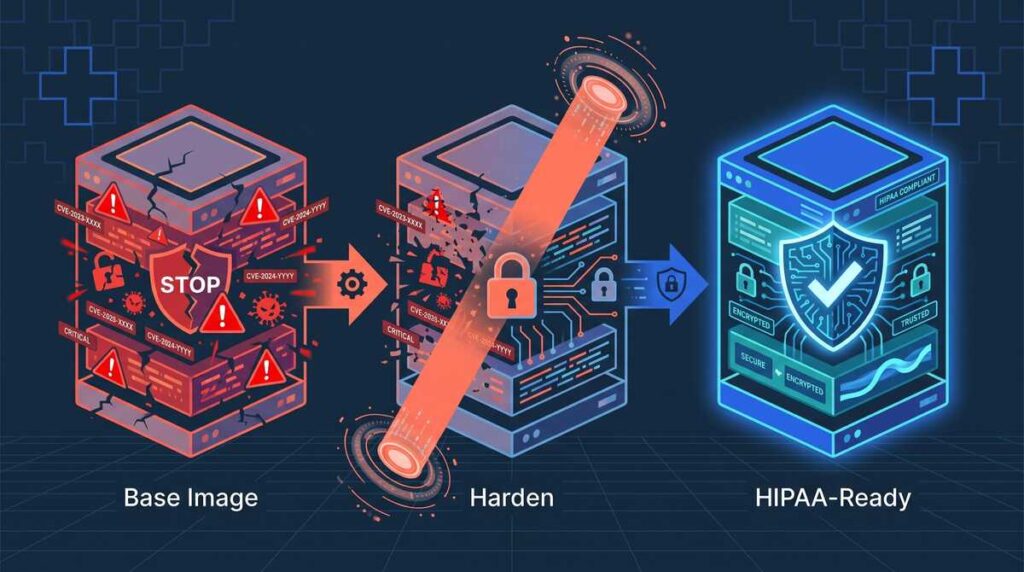
Healthcare DevSecOps pipeline: vulnerable base image hardened to HIPAA-ready container
Why Generic Container Security Falls Short in Healthcare
Most container security tools were built for cloud-native startups, not health systems. They flag CVEs, produce a report, and stop there. That leaves your team to manually triage hundreds of findings, map them to compliance controls, and produce evidence for auditors, all without breaking clinical uptime.
“Inherited vulnerabilities in third-party base images are now one of the top sources of HIPAA technical safeguard findings in containerized environments.”
The tools that serve healthcare well do more than scan. They reduce the attack surface, generate audit-ready evidence, and fit into pipelines without requiring you to rewrite your application stack.
Criteria Checklist: What to Evaluate
Vulnerability Management Across the Full Image Lifecycle
A scanner that runs at build time and stops there will miss drift. Look for tools that track vulnerabilities from base image through runtime, flag newly disclosed CVEs against images already deployed, and support continuous remediation rather than one-time scans. For HIPAA technical safeguard documentation, you need a record of what was vulnerable, when, and what you did about it.
Cost if absent: Auditors will ask for evidence of ongoing vulnerability management. A point-in-time scan report does not satisfy that.
Hardened Container Images or Automated Hardening
Pre-built hardened container images with minimal attack surface reduce inherited CVE exposure before your team writes a line of application code. If a vendor does not offer curated hardened bases or automated hardening workflows, you are left managing that work manually, which does not scale when your catalog grows.
Cost if absent: Every new service your team deploys inherits the full vulnerability footprint of a general-purpose base image. That compounds quickly.
Runtime Profiling and SBOM/RBOM Export
Compliance teams need to answer: what is actually running in this container, and what does it communicate with? Tools that generate a Software Bill of Materials (SBOM) at build time and a Runtime Bill of Materials (RBOM) during execution give you two layers of evidence. The RBOM is especially useful for demonstrating minimum necessary access, a principle that maps directly to HIPAA technical safeguards.
Pipeline Integration Without Application Changes
Healthcare environments often run legacy clinical applications that cannot be refactored. A security tool that requires OS-level changes, pipeline rewrites, or application code modifications will stall in change control for months. Prioritize tools that work as drop-in replacements for existing base images with no migration required.
Compliance Posture Coverage
Look for explicit coverage of HIPAA, HITRUST, FedRAMP (if relevant), FIPS, STIG, and CIS benchmarks. Vendors should be able to tell you which controls their tooling supports evidence generation for, not just which frameworks they claim to “align with.”
Consolidation and Staffing Reality
Most health system security teams are small. A tool that requires a dedicated engineer to operate is a staffing risk. Evaluate whether the platform consolidates scanning, hardening, SBOM generation, and remediation in one place, or whether you are stitching together four point tools and manually correlating the output.
Readiness Checklist: Container Security Audit Prep
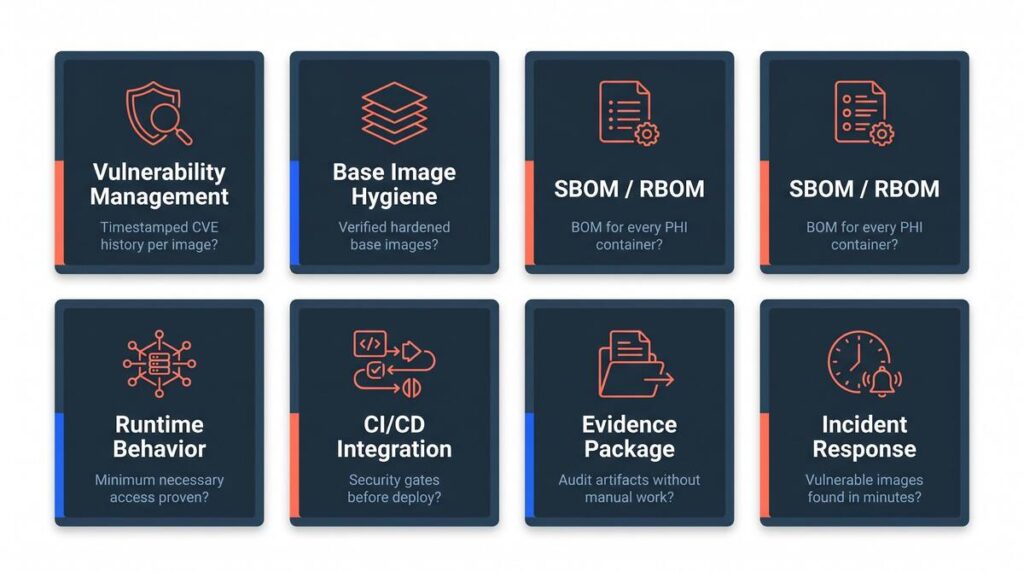
HIPAA container security readiness matrix: 7 criteria knolling comparison
Use this before your next HIPAA or HITRUST assessment:
| Area | Readiness Question |
| Vulnerability Management | Can you produce a timestamped history of CVE findings and remediation actions per image? |
| Base Image Hygiene | Are your base images hardened and sourced from a verified, curated catalog? |
| SBOM/RBOM | Do you have a current software bill of materials for every PHI-handling container? |
| Runtime Behavior | Can you demonstrate that containers have minimum necessary network and file access? |
| CI/CD Integration | Does security gate deployment, or is it a post-deploy scan? |
| Evidence Package | Can you export compliance artifacts without manual data assembly? |
| Incident Response | Can you identify all containers running a vulnerable image within minutes of a disclosure? |
If you answered “no” or “not sure” to three or more of these, your current tooling has a gap that a determined auditor will find.
How to Prioritize When Everything Feels Urgent
Start with blast radius. Identify which containers handle PHI directly, authenticate users, or sit at network boundaries. Those get hardened first. Everything else follows.
Then look at your inherited exposure. Pull an SBOM for your five most critical images and count the CVEs in your base layers. If that number is in the hundreds, you have an automated hardening problem, not a manual patching problem. No team patches its way out of 400 inherited vulnerabilities per image on a two-week release cycle.
Finally, map your tooling gaps to your next audit timeline. If you are six months out, you have time to evaluate and implement a consolidated platform. If you are six weeks out, prioritize evidence generation for what you already have deployed, then fix tooling afterward.
Frequently Asked Questions
Does container security software count as a HIPAA technical safeguard?
HIPAA’s Security Rule requires covered entities and business associates to implement technical safeguards that protect ePHI. Container security tooling supports several of these requirements, including access controls, audit controls, and integrity protections. The tooling itself is not a safeguard; how you configure and evidence it is. Work with your compliance counsel to map specific tool outputs to your Security Rule implementation.
What is the difference between an SBOM and an RBOM?
An SBOM (Software Bill of Materials) inventories the components packaged into a container image at build time. An RBOM (Runtime Bill of Materials) captures what a container actually loads and communicates with during execution. Both matter for compliance: the SBOM tells you what could run, and the RBOM tells you what did run. Together they provide the kind of layered evidence that supports HITRUST assessments and HIPAA audit inquiries.
How does automated hardening differ from patching?
Patching applies a fix to a known vulnerability in a running system. Automated hardening removes unused packages, libraries, and capabilities from a container image before deployment, so the vulnerable code is never present in the first place. Tools like RapidFort use runtime profiling to determine what a container actually needs, then strip everything else, which can reduce the attack surface and CVE count substantially without touching application code.
Can we harden containers without changing our CI/CD pipeline?
Yes, if you choose tooling designed for drop-in compatibility. The cleanest approach is replacing your base images with pre-hardened equivalents that are API-compatible with Alpine, Debian, UBI, or Ubuntu LTS. Your Dockerfiles reference the new base; nothing else changes. Some teams prefer to add a hardening step in their pipeline as a post-build stage. Either path works, but the drop-in approach has the lowest change-control friction in regulated environments.
Closing
Container security in healthcare is not optional, and it is not a one-time project. Vulnerability management is an ongoing operational requirement under HIPAA, and auditors are getting better at asking container-specific questions.
The teams that struggle most are those running general-purpose scanning tools and trying to manually bridge the gap to compliance evidence. The teams that manage it well have consolidated tooling that handles hardening, SBOM generation, and runtime profiling in one place, and can produce an audit package without a two-week manual effort.
The cost of inadequate container image security is not just a finding letter. A PHI breach traced to an unpatched container vulnerability can trigger breach notification requirements, OCR investigations, and reputational damage that takes years to recover from.
Start with your highest-risk images. Measure your inherited CVE exposure honestly. Then choose tooling that reduces that exposure automatically, generates evidence your auditors will accept, and does not require you to hire three more engineers to operate it.