
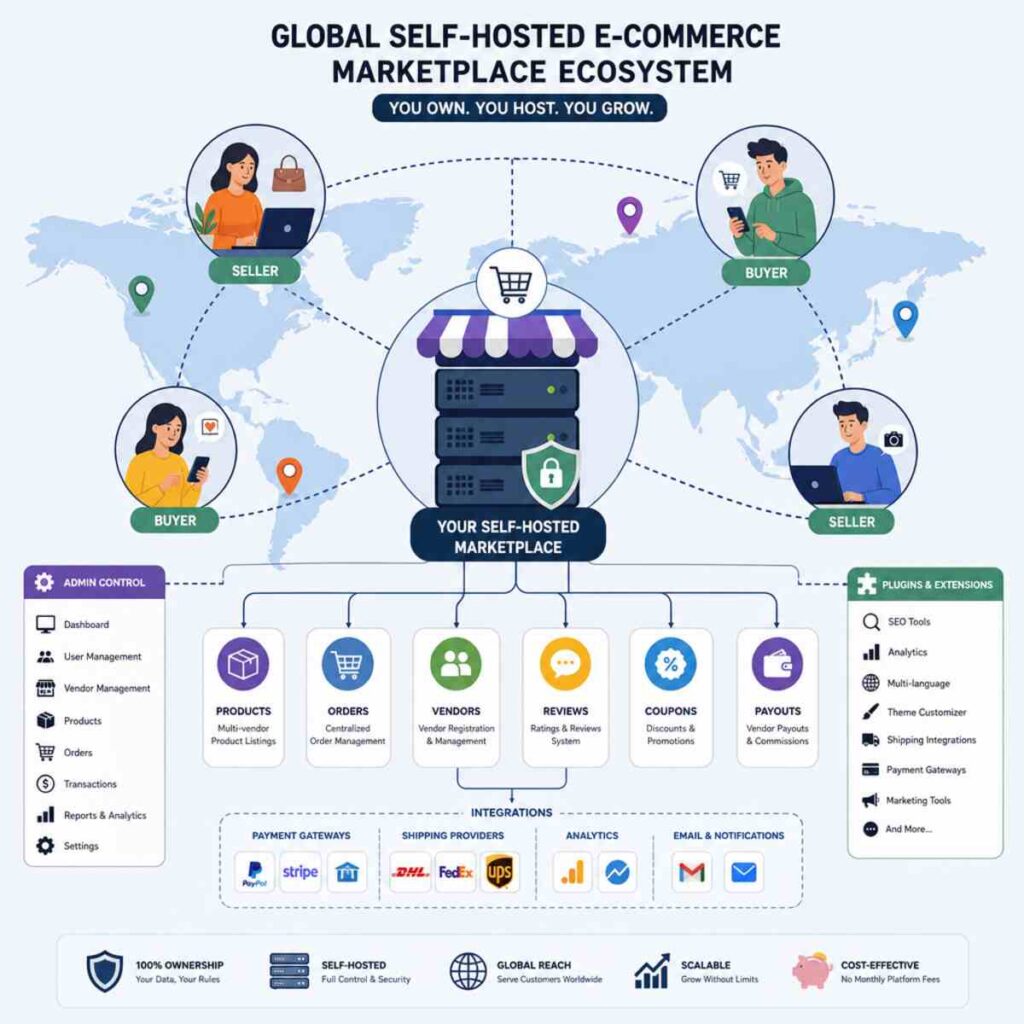

The e-commerce landscape has fundamentally shifted. Today, the most lucrative and scalable business models are no longer traditional single-vendor stores, but expansive, multi-vendor marketplaces. Whether you want to create the next niche Etsy, a localized Uber-style service platform, or an expansive B2B procurement hub, owning the underlying technology provides an unparalleled competitive edge. The Amazing fact about CS-Cart Multi-Vendor.
While Software as a Service (SaaS) solutions offer quick setups, they often come with restrictive vendor lock-in, inflexible features, and mounting monthly fees that scale aggressively alongside your success. For entrepreneurs and enterprises seeking complete control, diving into the world of self-hosted solutions is the definitive path forward.
In this comprehensive guide, we will explore the Best Self-Hosted Marketplace Options available today. We will break down everything from technical infrastructure and security considerations to payment routing and vendor management, providing you with a complete roadmap to launching and scaling your digital ecosystem.
Why Choose a Self-Hosted Approach?
Before diving into specific platforms, it is crucial to understand why so many successful marketplace founders eventually migrate to or start with self-hosted infrastructure.
When you evaluate self-hosted vs saas marketplace platforms, the core differentiator always comes down to control. SaaS platforms operate on rented digital real estate. You are bound by their terms of service, their feature rollouts, and their server limitations. Conversely, self-hosting means the software resides on servers you control (whether on physical on-site servers, virtual private servers, or cloud environments like AWS and Google Cloud).
The Pillars of Self-Hosting Benefits
- Absolute Customization: You are not limited by the API constraints of a SaaS provider. You have access to the underlying code, allowing for deep integrations with proprietary CRM, ERP, or logistic software.
- Marketplace Data Ownership and Privacy: In a world governed by GDPR, CCPA, and increasingly strict data compliance laws, controlling where and how your user data is stored is a massive liability shield. Self-hosting ensures that neither your platform provider nor a third-party app can leverage your proprietary customer and vendor data.
- Predictable Long-Term Costs: While upfront development costs are higher, the ongoing infrastructure expenses are tied directly to your server usage, rather than an artificial tier based on your transaction volume or gross merchandise value (GMV).
- Unrestricted Revenue Models: You can implement any monetization strategy you choose without a platform taking an unnegotiated cut of your revenue.
Understanding the Financial Commitment
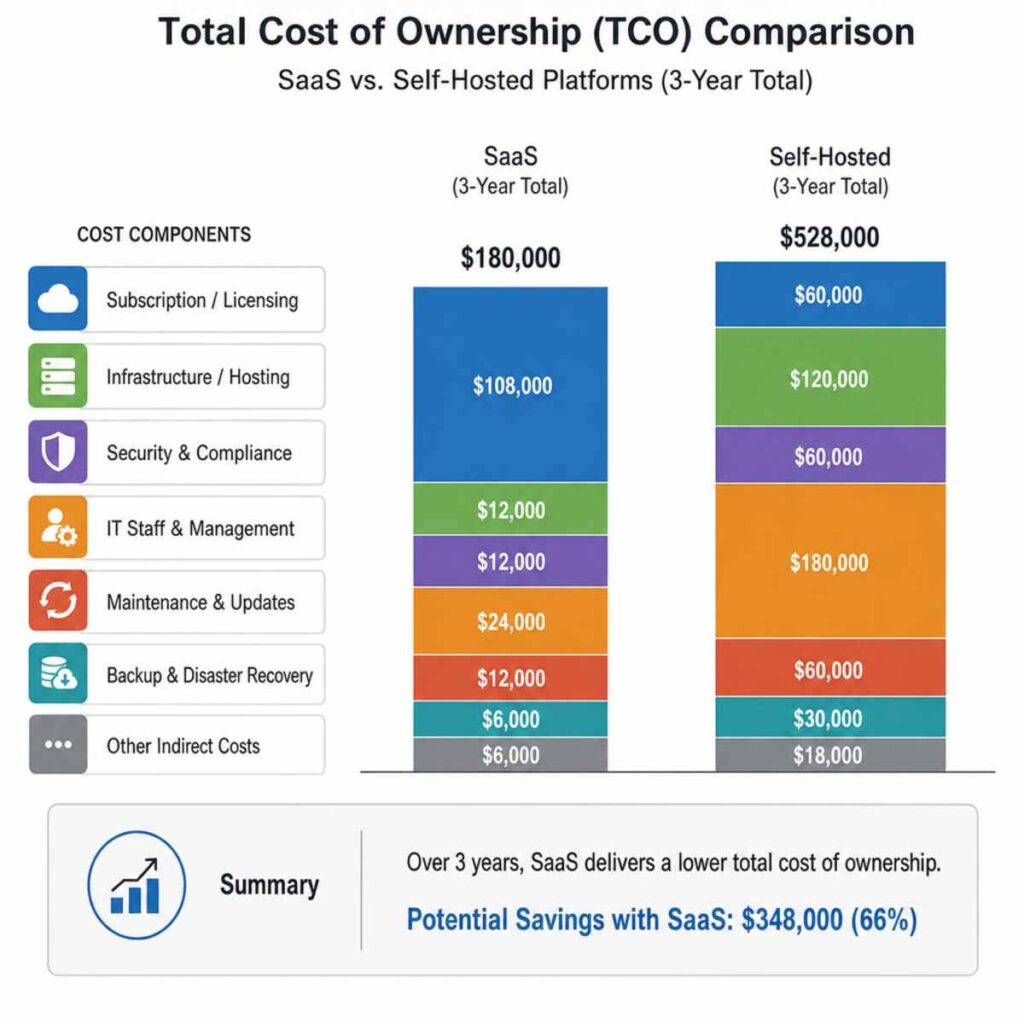
Before selecting your platform, it is imperative to calculate the total cost of ownership for self-hosted marketplaces. While the software itself might be free or require a one-time fee, running a marketplace involves several ongoing financial commitments:
- Infrastructure and Hosting: Depending on traffic, cloud hosting can range from $20/month for a digital ocean droplet during testing, to thousands of dollars a month for enterprise-grade, load-balanced AWS setups.
- Development and Maintenance: You will need in-house developers or agency partners to handle updates, bug fixes, and feature deployments.
- Security Licensing: Premium SSL certificates, web application firewalls (WAF), and routine penetration testing.
- Premium Plugins and Extensions: Even open-source platforms often require paid add-ons for specific functionalities like advanced vendor analytics or localized shipping integrations.
By mapping out these costs over a 3 to 5-year timeline, you will generally find that while self-hosting requires a higher initial investment, the TCO becomes significantly lower than enterprise-level SaaS solutions once you hit high transaction volumes.
Evaluating the Top Marketplace Platforms
When it comes to selecting the foundation for your business, the market offers a diverse array of ecommerce platforms and specialized marketplace software. Below is a deep dive into the industry’s most robust self-hosted marketplace options, categorized by their ideal use cases.
1. Magento (Adobe Commerce) with Multi-Vendor Extensions
Magento has long been the undisputed king of complex, large-scale self-hosted e-commerce. While the base platform is designed for single vendors, adding robust extensions from providers like Webkul or Mirasvit transforms it into an enterprise-grade multi-vendor marketplace.
- Best For: Large enterprises, massive B2B marketplaces, and platforms requiring extreme catalog complexity.
- Pros: Unmatched scalability, incredibly robust feature set, deep integration capabilities, and highly sophisticated inventory management.
- Cons: Notoriously steep learning curve. Requires specialized (and often expensive) Magento developers. Heavy server resource requirements.
If you are planning on scaling custom marketplace infrastructure to handle millions of SKUs and tens of thousands of simultaneous users, Magento’s architecture is built to withstand that pressure.
2. WordPress + WooCommerce Multi-Vendor Plugins
WordPress powers over 40% of the web, and its e-commerce extension, WooCommerce, is incredibly flexible. By leveraging the top rated multi-vendor plugins for wordpress, you can turn a standard WooCommerce store into a thriving marketplace in a matter of days.
The “Big Three” plugins in this space are:
- Dokan Multivendor: Known for its highly intuitive frontend dashboard for vendors. It offers an experience similar to Shopify or Etsy for sellers, making vendor onboarding seamless.
- WCFM Marketplace: A favorite among developers due to its overwhelming array of features and deep customization options. It supports a vast array of product types, including bookings and appointments.
- WC Marketplace (MultiVendorX): Highly customizable and excellent for niche marketplaces requiring specific commission rules and detailed vendor storefronts.
- Best For: Startups, small to medium-sized businesses, content-driven marketplaces, and those looking for low cost self-hosted marketplace alternatives.
- Pros: Enormous community support, thousands of compatible plugins, highly cost-effective, and excellent SEO capabilities out-of-the-box.
- Cons: Can become bloated and slow if too many plugins are installed. Scaling requires meticulous database optimization and specialized WordPress hosting environments.
3. CS-Cart Multi-Vendor
Unlike Magento or WooCommerce which require extensions to become multi-vendor, CS-Cart Multi-Vendor is purpose-built as a marketplace from the ground up. It is widely considered one of the absolute best standalone self-hosted platforms.
- Best For: Serious entrepreneurs who want a dedicated marketplace solution without the “hacked-together” feel of some CMS plugins.
- Pros: Over 500 pre-built marketplace features, independent vendor panels, robust micro-store customization, and an excellent admin panel for the marketplace owner.
- Cons: The upfront licensing fee can be expensive (ranging from roughly $1,450 to over $7,500 for the enterprise edition). Customization requires Smarty template engine knowledge.
One of the standout features of CS-Cart is that it acts as highly configurable white label marketplace software with source code provided. This means agencies and developers can completely rebrand the software, strip out what they don’t need, and build a truly bespoke proprietary platform on top of a battle-tested core.
4. Sharetribe Go (Open-Source Version)
Sharetribe is famous for its SaaS offering, but they also maintain a robust open-source version of their software, hosted on GitHub. If your goal involves building a peer-to-peer marketplace from scratch (like an Airbnb for camera equipment or a local service-sharing hub), Sharetribe’s open-source repository is a goldmine.
- Best For: Rental marketplaces, service-based platforms, and peer-to-peer (P2P) communities.
- Pros: Free to download, explicitly designed for the P2P and rental models, clean user interface, and highly specialized for user interaction rather than just retail cart checkouts.
- Cons: Requires strong Ruby on Rails knowledge to deploy and customize. The open-source version lacks some of the newer features found in their premium SaaS tiers.
Using Sharetribe as your open source multi-vendor software allows you to launch quickly while retaining the ability to rewrite the codebase as your unique community needs evolve.
5. Developer-Focused Frameworks and Scripts
For technical founders who view existing platforms as too restrictive, building upon a headless e-commerce framework or specialized script is the ultimate power move.
Solutions like Sylius (based on PHP/Symfony) or Spree Commerce (Ruby on Rails) offer incredibly clean codebases. While they are fundamentally e-commerce frameworks, there are vast libraries of open source marketplace scripts for developers that can be integrated to handle multi-vendor logic.
- Pros: You are building exactly what you need with zero bloat. Maximum performance and ultimate scalability.
- Cons: Highest development cost and time-to-market. You are essentially building the marketplace infrastructure from the ground up.
Step-by-Step: How to Host Your Own E-commerce Marketplace
Once you have selected your software, the real work begins. Understanding how to host your own e-commerce marketplace is just as vital as the software itself. A poorly hosted marketplace will suffer from downtime, slow loading speeds, and security vulnerabilities, all of which destroy user trust.
Phase 1: Planning Your Server Architecture
A multi-vendor marketplace requires significantly more server resources than a traditional blog or portfolio site. Every time a user searches for a product, checks out, or a vendor uploads an image, heavy database queries are executed.
- Avoid Shared Hosting: Shared hosting environments will choke under the weight of marketplace database queries.
- Start with a Managed VPS: A Virtual Private Server (VPS) from providers like Cloudways, RunCloud, or Kinsta offers dedicated resources.
- Graduate to Cloud Infrastructure: As you grow, transition to AWS (Amazon Web Services), Google Cloud Platform (GCP), or DigitalOcean. You will want to decouple your architecture.
- Web Servers: Handle the incoming traffic.
- Database Servers: Separated for security and speed (e.g., Amazon RDS).
- Object Storage: For user-generated content and vendor images (e.g., Amazon S3).
Phase 2: Deploying On-Premise E-Commerce Platform Security
When you host your own marketplace, the liability of securing transaction data falls squarely on your shoulders. On-premise e-commerce platform security must be proactive, not reactive.
- SSL/TLS Certificates: Essential for encrypting data between the browser and the server. Never launch without a forced HTTPS connection.
- Web Application Firewall (WAF): Implement a WAF like Cloudflare or Sucuri. This sits in front of your server and blocks malicious traffic, SQL injection attacks, and DDoS attempts before they ever reach your application.
- Strict User Roles and Permissions: Ensure vendors can only access their specific data siloes. A vulnerability in one vendor’s dashboard must not compromise the entire database.
- Regular Backups and Penetration Testing: Configure automated, encrypted off-site backups daily. Hire ethical hackers annually to perform penetration tests to find vulnerabilities in your custom code.
- PCI Compliance: If your servers touch credit card data, you must be Payment Card Industry (PCI) compliant. Actionable Tip: Offload this burden by using tokenized payment gateways (more on this below) so actual card data never touches your self-hosted servers.
Phase 3: Customizing Multi-Vendor Store Functionality
The success of your platform heavily relies on the vendor experience. If it is difficult for sellers to upload products, track orders, or request payouts, they will abandon your platform for a competitor. Customizing multi-vendor store functionality is where your self-hosted platform truly shines.
- The Frontend Vendor Dashboard: Vendors should not have to navigate complex backend admin panels. Ensure your platform provides a clean, front-end dashboard where they can view sales charts, manage inventory, and respond to customer queries.
- Granular Shipping Controls: Allow vendors to set their own shipping zones, table rates, and integrated carrier calculations (like FedEx, UPS, or USPS).
- Storefront Branding: Give vendors the ability to upload their own banners, logos, and store policies, creating a “mall” experience rather than a monolithic store.
Managing the Financial Engine: Commissions and Payments
The lifeblood of your marketplace business model is how you handle the flow of money.
Managing Vendor Commission Structures
Your platform must be flexible enough to accommodate various monetization strategies. Managing vendor commission structures requires software that can handle complex mathematical rules at the point of checkout.
Common commission models you will need to configure include:
- Global Percentage: The marketplace takes a flat cut (e.g., 10%) of every transaction.
- Tiered Commissions: Incentivize high-volume sellers by lowering your cut as they hit sales milestones (e.g., 10% for the first $1,000, 8% thereafter).
- Category-Specific Commissions: Electronics might have a 5% margin, while digital art might carry a 20% margin. Your software must be able to calculate cart contents with mixed categories and parse the commissions accordingly.
- Vendor-Specific Rules: You may want to offer VIP vendors better rates to entice them to join your new platform.
- Subscription Models: Instead of taking a cut of sales, you charge vendors a flat monthly fee to list their products on your self-hosted platform.
Implementing Secure Multi-Vendor Payment Gateways
Routing money in a multi-vendor environment is legally and technically complex. When a customer buys Product A from Vendor 1 and Product B from Vendor 2 in a single checkout, how does the money split? Who pays the credit card processing fee?
Implementing secure multi-vendor payment gateways solves these logistical nightmares. You cannot simply use a standard PayPal or Stripe business account, as taking custody of third-party funds before paying them out can classify your business as a Money Services Business (MSB), which carries massive regulatory burdens.
Instead, you must integrate specialized multi-party gateways:
- Stripe Connect: The gold standard for marketplaces. It handles KYC (Know Your Customer) compliance for your vendors. When a transaction occurs, Stripe automatically splits the funds, sending your commission to your account and the remainder directly to the vendor’s bank account.
- PayPal Commerce Platform for Marketplaces: A robust alternative that allows complex split payments, delayed payouts, and handles the intricate compliance requirements of a global marketplace.
- Mangopay / Adyen: Excellent options for complex European marketplaces or massive enterprise platforms requiring deep localization and diverse payment methods.
By utilizing these tools on your self-hosted setup, you maintain absolute control over the user checkout experience while offloading the severe legal liabilities associated with money transmission.
Conclusion: The Roadmap to Your Digital Empire
Choosing to build on self-hosted infrastructure is a declaration of intent. It signifies that you are not just building a temporary storefront, but a highly scalable, fully customizable digital asset that you truly own.
By carefully evaluating the self-hosted marketplace options—whether that means leveraging the massive community of WordPress, the enterprise power of Magento, the dedicated architecture of CS-Cart, or custom open-source scripts—you set the foundation for limitless growth.
Remember that the technology is only one piece of the puzzle. Success requires meticulous attention to server architecture, a flawless user experience for your vendors, airtight security practices, and a rock-solid payment routing system. Take the time to plan your infrastructure, understand your total cost of ownership, and choose the platform that aligns perfectly with your long-term business vision. The marketplace economy is booming, and with the right self-hosted platform, you hold the keys to your own digital empire.